becopoetry

Poetry Music Thoughts and Reflections

Vale Gloria — January 31, 2025

Vale Gloria

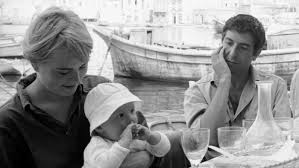
Photograph by Willow Lewis

Vale Gloria Mary Clarke (nee Mullins) 18/04/35 – 05/01/2025

Ashes spread into Narrm, Port Phillip Bay on February 1st 2025

Funeral held On Thursday 16th January 2025

Tribute to Nan:

Welcome everyone, we are here today to say goodbye to, and to celebrate the Life of Gloria. For anyone here who might not know me I’m Beccy one of Gloria’s grandchildren. firstly I would like to thank Gloria’s children especially Leanne for trusting me to open and guide today’s spoken proceedings. I would also like to acknowledge that we are on Wurundjeri County of the Woi-wurrung Nation, and would like to especially acknowledge all the grand-mothers that live, have lived, will live, and have passed on these lands for thousands of years.

 to Nan – to Gloria

1935: April 18th Gloria Mary Mullins, was born. Same year Elvis was born 

– obviously, a year for icons to come to life. Elvis may have shaped rockn’roll, but Gloria shaped a clan – with 5 children, 20 grandchildren, at least 27 great grandchildren that I could count and now a couple of great great grandchildren, Gloria outlived Elvis to mold four generations. G_L_O_R_I_A Gloria, married in 1955 to become Gloria Mary Clarke. 

G-L-O-R-I-A – Gloria Loved by Ray, Shirl, Raylene, Karen, Greg, Leanne, her sons-in-laws John and Werner, and too many grandchildren, great grandchildren and great great grandchildren to name! Matriarch to a massive clan – our clan -What a woman!

In preparation for this funeral a playlist of Gloria’s favorite songs was made. Of course the famous Van Morrison song GLORIA had to be included. You know the one. I only mention this song especially now because a strange thing happened in my car last Tuesday as Me and Brett were on our way to drop my daughter Willow home after spending some time with Lee and Werner and Gabby organising some arrangement for this day. In my car as usual My Brett took over DJ role and put on one of his electronic drum and bass play lists on Spotify. Not my favorite but tolerable. We were nearing Willow’s dad’s house to drop her off when we noticed Brett’s playlist had weirdly been interrupted by a song not on that list… And her name is G_L_O_R_I_A – van Morrison’s Gloria, we were a bit stunned and trying to work out how on earth that could happen. Crocodile rock came on next and Willow hopped out of the car. As we drived away weirdly the next track saw the resumption of Brett’s drum and bass playlist. Brett was freaked, I said it must be Nan doing it. She’s still with us. I think she approves of the playlist.

Now, I know everyone believes all sorts of different things about what happens after death. But last Tuesday I honestly felt like she was there letting us know that she still present. maybe just for a little while, maybe for longer. I don’t know… but I do feel it. And I feel like she’s with us today. And I think whether we speak our words out loud or silently to her, or even if we have wordless messages that come as feelings that we want to send, I feel like she will receive them. So even if you’re not speaking or not having words spoken for you here today, if it feels right, I invite you to send your messages to her.

There is so many things to remember about Gloria. When writing this for me her Collingwood flat was at the forefront of my mind. It was Gloria’s home base from 1981- 2024. A place she always decorated with pride, I remember her once telling me if she had her time again she’s be an interior decorator, in her place she got to express that talent. In the 80s when I was little I also remember it being a warm hub for all her family – when Lee and Werner first got together they lived there, and Pop, Raymond was often there and I remember several family feasts with aunties and uncles and cousins where nan just made too much food for all of us. I also remember spending many a night when I was little snuggled up there with her, often with my brother Andy, often with my cousins Melanie and Jason and often just me and her.

So with that I’d like to start the personal tributes to Nan with a story I wrote in 2017 after spending a series of days at her Collingwood flat interviewing her on all sorts of matters of life and love.

This is for you Nan …

Nan. Nanny. It was 1982. I was five years old. I was in my bedroom. The pink walls were spinning. I was dancing and singing to Laura Branigan’s Gloria. ‘Gloria! I think they got your number/ I think they got the alias/ that you’ve been living under.’ I was practicing the song for you, Nanny. Remembering all the words so I could sing them for you. ‘But you really don’t remember/ was it something that they said/ all the voices in your head/ calling Gloria.’

In the 1980s, all through primary school I was called a fatty Buddha by the boys. But with you I felt like a precious baby Buddha. So many Fridays you would train down to Frankston and Mum would pick you up from the station and deliver you to our bush home in Mt Eliza. I loved every weekend you stayed but I loved it even more when you took me back with you. Those Friday nights when we caught the train to the city. Our routine: to go to Bourke street, to go to Myer. You’d talk about your ‘lairy’ taste and how you loved colour. You’d always buy me and yourself a new dress and box Tim Tams each, afterwards we’d head home on the Hurstbridge line towards your sixteenth-floor flat. 

I could spot your building two stops before we got to your station in Collingwood; it towered over all the others taking the sky. The pinkish veneer dotted with hundreds of cream rimmed windows. No one else at school had a Nanny that lived in the sky. I was the lucky one. The elevator up to the sixteenth floor had a funny smell and sometimes felt sticky, getting off at your floor a wind often swept through as if spirits haunted the corridors, but on walking through your door everything became warm. You’d straighten the Elvis Presley mirror that hung above the dining table and I’d wander through the rooms feeling greeted by all the smiling faces of your Happy Buddhas and the other figurines that filled your flat. All those figurines that you painted black or red to match your decor. Even Jesus didn’t escape the paint job. The figure on the cross on the wall at the end of your bed coated black to match the colour of your Doona. 

At the end of those Friday nights our heads cradled on soft red cushions. Me cuddled up in your arms. The smell of your Pond’s moisturiser gentle on my nose. With your cheek close to mine, I’d giggle through your stories, hearing of old days when you were little girl and stories about the shenanigans of my mum and uncle and aunts when they were little.

Today on a Thursday in 2017, I’m back in the sticky elevator on my way up to sixteenth floor. The elevator doors open and that familiar wind greets me. Then you greet me in one or your ‘lairy’ blouses. 

Inside you begin to fill me in on family gossip as we wonder your rooms. And the Buddhas are still smiling everywhere but in your bedroom the Jesus figurine has long been replaced with a picture of the ocean. On your bedside table is a book titled ARE YOU LONESOME TONIGHT? The Untold Story of Elvis Presley’s One True Love and the child he never knew.

In the lounge room on the dining table you have lunch set out for us, bread rolls, chicken and salad. I pull the packet of TimTams from my bag and place it on the table. Your breath is heavy as you walk to the kitchen to put the kettle on. You ask me if I want a coffee. I tell you to sit down, I’ll make it. You say, “you’re not making me a coffee, I can still make a coffee for my grand-daughter”.

As I wait while you make us Nescafé, I notice the Elvis Presley mirror that once hung above the dining table is gone. It makes me remember a morning with you when I was little: You were vacuuming you’re carpet swinging your hips and singing, “Uptown girl/ she’s been livin in her uptown world/ da da da da da da da.” You never quite knew all the words. You told me Billy Joel was your favorite and you wanted Uptown Girl played at your funeral. ‘Nanny that’s silly.’ I had said, ‘What about Elvis, I thought Elvis was your favorite.’ you looked lovingly at the large Elvis Presley mirror that hung above your dining room table. ‘Yes, Elvis is me favorite.’ then you told me that my mother Karen bought you that mirror the day Elvis died.’ 

It’s while you’re still making that coffee that I think about my connection to you, and how I’ll feel when you gone. I don’t want to imagine it. I adore you too much. The connection runs deep. The reality is Nan, that for me and for all your daughter’s children, that our first connections to life was in your body: our cellular beginnings, like Russian dolls in the dark, was as eggs in our unborn mother’s ovaries, inside your womb. Part of us began in your body Nan. How amazing is that!

After lunch, I ask you if you mind if I record our conversation. You say I can do what I like. You follow this up by saying you can’t stand the lies they say at funerals though. I say, “I’m not writing a eulogy here nan, but what do you mean by that?”

      You say ‘They say is how great he was or what a nice lady she was. At my funeral, you won’t be saying that about me!’

            ‘what would you like me to say about you Nan?’ 

            “that Nan had the worst temper ever going”

We laugh. Then you say, ‘Death doesn’t scare me but living till a hundred does. I enjoy life, But I honestly don’t want to live till I’m 100, that’s not my ambition. What can you do in your 90s anyway? Shopping would be exhausting”

We laugh then pause then you say:

“When I was a kid, I used to think I had a soul that goes on. But now I think it’s just your genes that go on into the next generation. Like you have a bit of me, your kids have a bit too. It gets watered down as you go along. But I think there’s always gonna be a little bit of me in all of you.” 

I love this Nan and I ask you what you think love is? 

You say ‘I think love is like the Catholic religion, you can’t touch it. But it means you love your family and your children.” You pause then add “When you’re young it gets mixed up in sex. It’s an emotion that can get you in a lot of trouble”.

I look down at the photo album, it is full of pictures of your children and grandchildren. 

I ask about your mother that died when you were two.

You say “I only know what they told me. They said she made my dad promise to never remarry and she made him promise to bring me up catholic. They said she was delicate.’

I ask you if you ever missed having a mother. You say, ‘I had my Gran. She was protective.’

You say: I used to get away with a lot of things with my dad. Dad would say I was delicate like my mother. My Gran would say, “delicate my foot.” “My Gran was like a mum. Dad was a drover so he was away a lot. She would have been in her 50s when she was bringing us up. I didn’t know who my grandfather was. My dad used to say that he was sent out here from Ireland for pinching a pig but we never found out if that was true or not. He took off on Gran when her kids were little. She raised seven kids on her own, then had to raise my brother and me. If someone went crook at us, Gran would defend us, but then yell at us when they were gone. I remember being dragged in by the ear a lot. My gran was a strong person.” 

I imagine your Gran. And I think of how you were protective of me when I was little. I remember my best day at primary school. I was in grade 4, You came on a school excursion with me and my mum. I was nine. We were on the bus making our way to Coal Creek, a pretend pioneer village. You were sitting next to mum in the seat in front of me. There was a loud group of boys up back. They started talking about me then one of them sang out, “Rebecca’s a fatty Buddha.” 

Your body turned towards the back like lightning. Your head seemed to fill the bus aisle. 

‘Hey you. You shouted pointing at the boy, ‘You should take a good look at yourself in the mirror, you’re not such a hot little thing.’ Everyone on the bus was quiet till you relaxed back into your seat. I heard someone mumble, ‘That’s her Nanny.’ No one teased me for a while after that day. You’re the best Nanny.

… 

NanNan, Mum, Aunty Gloria, Glors, Gloria – you’re the best…

Fiery, feisty, fiercely protective with a gentle hug that made any recipient feel fully held. 

You had the Blarney Stone gift of the gab with a million stories to tell.

so many stories to remember about Gloria… I look forward to hearing more stories and words for Gloria whether it’s up here, after the proceedings, or later at the Croxton when we toast Nan more informally. 

Thank you everyone for listening to my words about nan, and thankyou Nan for sharing your quirky wisdom with me. Your body left us on January 5th, 2025, but as you said Nan a bit (I think maybe even a lot) of you goes on in all of us – your children, grand-children, great grandchildren, great great grandchildren, and your love remains in the hearts of all the people that loved you.

So, with that Nan, in a moment your grand-daughter Bella’s gonna come up to speak, then then Ray/Poppy, then your Children.

But before that I just have a couple of tributes to share with you:

from your great grandchild Willow:

“Nannan has been a wonderful inspiration and a great nan. I feel so privileged to have known my great grandmother as most people don’t get to meet them. The last thing I told her was how I always appreciated her looking after me and making me laugh I told her that one of My favourite memories as a child with her was when she used to look after me Bella cadence and gabby. We used to play a karaoke game where she would judge our karaoke voices. She always did things like that with us to entertain us when we were younger. Nan Nan will always be cherished in my heart and I’m grateful that I got to spend 22 years of my life with her. I hope she rests in peace and I wish her best of wishes in her afterlife.”

From your brother and sister in-law Noel and June Clarke and their extended family:

A tribute to Gloria Mary Clarke (nee Mullins)

“We give thanks for the many happy memories we shared together as the Clarke family over the passed 70 years. Gloria will be sadly missed by us all, and our hearts and thoughts go out to Ray and his extended family during this difficult time.

Resting where no shadows fall, in perfect peace she awaits for us all
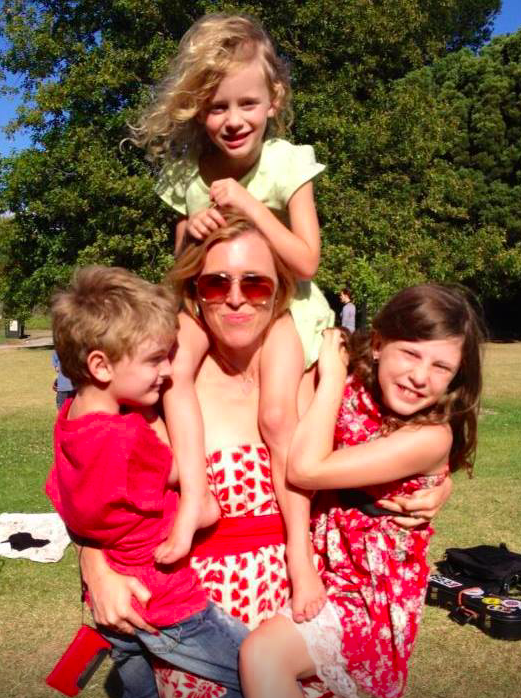
For I Will Consider — March 9, 2019

For I Will Consider

For I Will Consider My Children

                        (After Mary Oliver and Christopher Smart)


For I will consider my son Maximus

For he plays the one broken key on our piano with gusto

For he climbs the shelves of my pantry in search of tea

For he chases sparrows at federation square

For he has three hour baths

For he claps and spins to SBS Chill

For he can play 17 rhythms on Djembe and can bang them on guitar

For he sings the words I think I’m gonna cry WAH WAH

For he collects real estate magazines and reads the oxford dictionary

For in a crowded theatre he laughs loudly at the sad parts of the film

For when it’s cloudy outside he tells me the sun is gone

For when I tell him I’ll see him next Friday

he hugs me a little tighter


For I will consider my daughter Willow

For she hates dresses that go past her knee

for she has adopted my hooded leather jacket

For when I tell her I love her she says ok unless its mothers-day

For she keeps her door closed and asks me to always knock

For she refuses to wear a hat to protect her mulberry birthmark

For she is terrified of the daddy long legs

For she uses her whole body to flip the two-handed-double-fingered-bird

For she lent me a dress on valentine’s day

For on her desk are two guitars a make-up case and a broken calculator

For she tells me what’s good on Netflix but asks that I watch when she’s not around

For above her bed is her first painting – a cave composed before kindergarten

For when she switches off her night light she quietly yells

mum are you still awake?


For I will consider my daughter Cadence

For she knows how to make eighteen different types of slime

For her bedroom carpet is ruined

For she wants to be an actor when she grows up or a chemist or both

For she has a book called ‘Cat Body Language – 100 Ways to Read Their Signals’

For she has a cat scratch on her chin

For she tells me she has decided to start calling me mother

For her new year’s resolution is to have less drama at school and to get a boyfriend

For when we read side-by-side she announces any gramma errors she encounters

For she can count her breaths backwards from 150

For she sleeps next to me seven nights out of fourteen

For of those seven nights her last words are mummy

I love you like an atom


For I will consider my children Maximus Willow and Cadence

For I will consider them while atoms still exist


Tribute to M. NourbeSe Philip and Zong! – Sensing the Unreasonable — December 3, 2016

Tribute to M. NourbeSe Philip and Zong! – Sensing the Unreasonable

French philosopher Philip Lacoue-Labarth says ‘A poem wants to say; indeed, it is pure wanting to say.’ Contrary to Lacoue-Labarth, the poems of Zong! by M NoubeSe Philip don’t want to say, but instead wants to demonstrate in a visceral way, how words can be senseless and brutal.

Find the poetry of M. NoubeSe Philip here

Listen to Philip On Penn Sound here

Former lawyer, essayist and Caribbean-Canadian poet M. NoubeSe Philip, is versed in the language of reason, yet in her poetry she shows how reason can be irrational by humane standards. In this tribute to M. NoubeSe and her work Zong! I suggest that Philip ingeniously represents the brutality of transatlantic slavery to challenge the rational of colonised discourse. I have coined the term colonised discourse and define it as a style of language which is bound to the rules of reason; the type of discourse that colonises words into a system that is believed to be inherently reasonable and rational by the colonisers standards. In Philip’s work Zong! (2008) an entire section is constrained to the words of a piece of colonised discourse: Philip uses a two-page legal document, The Zong Case (1781), to give shape to her poems. The Zong Case also known as Gregson v. Gilbert, saw 150 African slaves murdered in order for an English slave ship owner to claim insurance. I argue that Philip’s Zong! uses the language of this case to create an anti-narrative that emphasises the silencing tendency of this type of discourse. I suggest the constraint that Philip employs, along with the dismembering of the words, creates a work that makes a reader feel disoriented, confused, alienated and horrified. I also compare James Walvin’s historic discourse on transatlantic slavery to Philip’s Zong! with purpose to show how present-day discourse is colonised and how it can be complicit in the violence of silencing the voices of minorities. I also propose that authors of colonised discourse may fear poetry, because they consciously or unconsciously fear that it effectively subverts ‘reasoned’ language.

Philip first encountered The Zong Ship story in James Walvin’s Black Ivory: A Historical of British slavery (1992), and the brutality of the story appears to have inspired her to look for another way to portray the history. In a chapter titled ‘Murdering Men’ Walvin speaks of The Zong case, Gregson v. Gilbert. Walvin describes how the captain of a slave ship named the Zong, made a navigational error that supposedly led to low water supplies, which led to a decision to throw some ‘cargo’ overboard, the cargo was 150 African slaves. The history tells us that decision was based on the captain’s knowledge that if the slaves died a natural death, then the underwriters would not be obliged to pay, however if the Africans were thrown into the sea alive, the slave ship owners could claim insurance. A legal case was put forth to the Chief Justice when the insurers refused to pay. This case ended up being the only record of this historical event. The two-page document Gregson v. Gilbert, cites Chief Justice Lord Manfeild’s ruling. Mansfield ruled in favour of the slave owners, and compared the African’s to ‘horses’ thus effectively legitimising their dehumanisation. On the acknowledgment page of Zong! Philip cites Black Ivory as an inspiration for her work (p.xi). But while Walvin’s discourse establishes, what in his words was “The most grotesquely bizarre of all slave cases heard in the English court” (Walvin 189), Philip’s Zong! portrays in her words “a story that cannot be told, but that must be told”. Thus, while Walvin emphasises the intent to focus on the factual evidence provided by colonised discourse, Philip suggests the story of those who were silenced must be told, but must be told in a way that shows what can’t be said.

The first section of Zong! titled Os (the Latin word for bones), signals Philip’s distrust for colonised discourse. Limited to the words of Gregson v. Gilbert case, Zong!1#-26# thoroughly disassembles the language of legal discourse and metaphorically throws it out to sea. In her prose that follows the poetry of Zong! Philip states her distrust of legal discourse and any language bound by ‘order, logic and rationality’ (Philip 197). She claims trust can only come in the language of song, parable, puns and ‘of course poetry’, suggesting that “in all these instances humans push against the boundary of language by engaging in language that is often neither rational, logical, predictable or ordered”. Thus in hacking the historical legal document into pieces, Philips creates an anti-narrative that asks the reader to be weary of the language of colonised discourse.

The tabular design of Zong! effectively supports the anti-narrative. Watkins proposes that tabular poetry is poetry that “one can’t move through it serially without paying attention to the infinite semantic possibilities which lie behind the code strings” and argues that ‘the non-rational poet writes to negate semantic closure’ (256 Watkin). Indeed, Zong! negates semantic closure, and frustrates any intention to pin meaning down or conclude a story. There is no anchoring in a soothing metre in Zong! and if any rhythm can be described it relates to the movement of the reader’s eyes (Scott 16-17).

“Tabular verse can be oralised and vocalised but rarely articulated. Rather than describing a rhythm, scansion describes the dynamic of the eye… if one can speak of rhythm at all, it is the rhythm of the collection and processing of information, the rhythm of the eye, its saccades and fixations, as it scans and rescans the text”(Scott 16-17)

The possible readings available with eye scansion are limitless and the effect can feel disorienting. Because many readings are possible I will describe the rhythm I experienced on first scanning Zong! 1#. My eyes were first drawn to the paralinguistic elements, the exclamation mark after the title evoked a sense of urgency, an urgency which was then fixed on the footer line placed above African names. I tried to read the stuttering sound units that were scattered on the page and found the alliteration jarring (“w” “w” “w” “w” “a”, ‘w a’ “t” ‘wa’ ‘wwwaa”), I was reminded of the sound of a baby crying or perhaps trying to talk for the first time: ‘goo’ ‘d’, “Wa”  “t” “er”, “w one” “dey” “day” “s” “wat” “wa ter” “of” “w” “ant”). Trying to make meaning of it caused tension, frustration and sense of thirst.  On a more peripheral reading of the pages, a spaciousness in my eyes was felt, and I began to take in the fullness of the design, I started to see an oceanic quality of movement and depth, a depth that contrasted with the flat stillness of the former page, I lingered on that flat page, anchored by the seven words written in boldface: The sea was not a mask – Wallace Stevens. My eyes were then drawn back to the scattered words and letters on the next page. The sea of words looked like bodies floating and I felt a tinge of shame, like I was watching something horrible but unable (or unwilling) to do anything about it. For me, the effect of the design created a kind of frantic rhythm that evoked disorientation, confusion and a sense of horror.

Zong! can be read on an electronic device, or in hard copy or a recital can be watched online, and each version brings differing experiences to show the work goes beyond what reason can say. My experience of scrolling down the pages of Zong! on a screen, gave me a sense of drowning, a sense that deepened when I scrolled down on the final section titled Ebora, which translates to mean ‘underwater spirits’ in the language of Yoruba. The final section of Zong!, “Ebora” is near impossible to read the words that are printed over the top of each other in light font. This has the effect of drawing attention to the last word that is printed clearly – “reason”. This last words double meaning perhaps emphasises the brutality of behind the “reason” for throwing 150 Africans overboard, by contrast with the inability of any humane “reason” to make sense of the event. On reading the hard copy, this downward quality of depth opened to a feeling of breadth, yet in both instances I felt I was searching for meaning in some mysterious and uneasy ocean. The disorganisation of words in Zong! seemed to represent an undoing that made room for a lot of white noise in the space around the words. In my experience of watching a performance of Zong!1# (Penn Sound, 2011), this white noise became excruciating. Blasing argues “Poetry ensures the audibility of the echoic personal – not in what is said but what is heard in the sound of what is said… a truth that cannot be arrived at by reason alone, a truth that the poet recognises by sensation” (Blasing 136).  Watching Philip reading Zong! 1# the pain on the poet’s body was palpable, I felt a visceral empathy in hearing the stuttering sound, sounds that evoked a sense of choking nausea. There is no need for Philip to say anything about the trauma that must have been experienced by those Africans aboard the Zong, what is not said can be felt in watery space of the screen or page, and on the skin as the poet reads. The multiple ways and multiple modes in which Zong! can be experienced, thus works to achieve something that goes beyond what reasoned language can say.

While Philip makes her distrust in colonised language felt, in Zong! she also shows that she does not extend this distrust to Western poetry. Quotes from Stevens, More, Thomas and others of the Western canon are inserted into Zong!, and each excerpt aptly support Zong!’s purpose. Steven Wallace says: ‘The sea was not a mask’ (As cited by Philip 2), and in Zong! 1# Philip shows us how the sea of language cannot hide the brutality of the Zong history; Thomas More says: ‘The poet is a detective and the detective is a poet’(As cited by Philip 100), and Zong! asks the reader to detect what’s beyond the surface of words and reason; Dylan Thomas says: ‘Though they go mad they shall be sane, / Though they sink through the sea they shall rise again…’(as cited by Philip vi) and Zong! allows the trauma African Ancestors to be felt in the sound and silence of the poetry. By using poets of the Western Canon, Philip shows how she trusts that poetry (new and old) has the power to subvert the reason of colonised discourse.

Walvin writes historical discourse on Slavery in the conventional way, and even though his discourse belongs to the rule of language that Philip distrusts, Philip has respectfully acknowledged his work, Black Ivory, as an inspiration for Zong!. Black Ivory recounts the brutal history of slavery with sympathy for the Africans who suffered, and Walvin’s intentions can be considered laudable in his desire is to bring awareness to the atrocities of slavery. This said the voice in his work remains constrained to Englishmen past and present, and therefore lacks an African perspective. Walvin cites words apparently spoken by the Captain of the Zong Collingwood:

“Collingwood told his officers: ‘if the slaves died a natural death, it would be the loss of the owners of the ship; but if they were thrown alive into the sea, it would be the loss of the underwriters.’ As a humane, though obviously specious, justification, he suggested that ‘it would not be so cruel to throw the poor sick wretches into the sea’” (Walvin, 1992, 16)

And in his own voice Walvin speaks of the Chief Justice Lord Mansfield who ruled in favour of the slave ship owner:

“When lord Mansfield died in 1793, he was laid to rest in Westminster Abbey, his memory celebrated in portraits and statues to be seen to this day in the National Portrait Gallery, Christ Church, Oxford and trinity Hall Cambridge. But where are the memorials to the thousands whose lives were touched by the career of the lord Chief Justice?”.(Walvin, 1992, 22)

In an interview, Philip recounts a time she talked with Walvin to inquire about the names of the Africans who were aboard the Zong. Philip politely relays Walvin’s uncomfortable chuckle as he apologetically explained that the Africans were known as ‘negro one, two’ and so on (Radio National, 2008).  Perhaps it was this conversation that inspired Philip to print African names in a footer, to create a memorial to those directly affected by slavery. Black Ivory assuredly gave Philip the desire to redress much of the logic behind the history, including the Captain’s reasoning for throwing the ‘sick wretches’ overboard and Lord Mansfield negation of the humanity of the African aboard the Zong. Zong! effectively redresses the history by bringing an African perspective to it, and Philip’s thus creates the memorial to those slaves who were silenced; It is this type of perspective and memorial representation that could assist in balancing Walvin’s conventional version of events.

Walvin’s historic discourse seeks to make sense of the history of slavery, but aspects of the language style and the absence of African representation, may implicate his discourse as being complicit in the silencing of African voices. In 2011, three years after Philip’s Zong! was released, The Zong by James Walvin was published. In the recommendations for further reading Philip’s Zong! is not cited, indeed nowhere in the book is Zong! mentioned. This leads one to question why a historian who proposes to be interested in slavery would not cite such an artwork completed from a person of the African diasporic community. It is especially conspicuous considering Phillip spoke to him personally during her research. One could argue that Philip’s Zong! as an artistic representation and therefore outside the bounds of formal historic discussion, yet considering Walvin dedicates a whole chapter of The Zong to Turner’s painting The Slave Ship this argument seems to falls flat. The Slave Ship is said to famously represent the Zong, and Walvin describes the painting as a “haunting portrayal of black bodies drowning beside the ship threatened by a looming storm” (Walvin, 2011, 3). Walvin credits the painting as being “a dazzling picture” (Walvin, 2011, 5) and at “heart a memorial” citing another historian who speaks of an ‘eminent art critic’ who claims that Turner’s work is the only ‘indisputable great work of Western Art made to commemorate the Atlantic Slave Trade (Walvin, 2011, 5). In further description, Walvin writes: “And what are those outstretched arms and hands? A final despairing wave from the wretches doomed to a terrible fate?” (Walvin, 2011, 4): it is uncomfortable to recognise that Walvin uses the same term (‘wretches’) to describe the Africans that he himself documents as being used by the captain who ordered their murder over 200 years ago: Captain Collingwood said ‘it would not be so cruel to throw the poor sick wretches into the sea’” (Walvin, 1992, 16).  Perhaps Walvin omits any mention of Philip’s Zong! due to defensive reasoning. Blasing claims

Discourse exercises power over the world of things; but poetry allows words to exercise power over discourse. This is a violence from within – not from within an “inner” subject, but from within a discursive medium, to counter its violence.  And without that counterviolence, we are prisoners of representation, with no hope of freedom.” (Blasing 143)

Philip indeed describes Zong! as a “a recombatant anti-narrative” (205). If as Blasing suggests poetry is a threat to disciplinary discourse, then could it be that Walvin is simply protecting his work? Poet Wallace Stevens writes:

The old men… are haunted by that

Maternal voice, the explanation of the night

(As cited by Blasing 138)

By failing to acknowledge Zong!, By favouring an English romantic painter as a memorialist, and by using the same term that the slave master used to describe the Africans he slaughtered, Walvin’s historical discourse becomes dangerously close to continuing a legacy of language that belittles, reduces and silences the African voice. With this in mind, the exclamation mark placed in the title Zong! perhaps signals the urgency needed now to end the complicity that continues to be adopted in some types of disciplinary discourse.

Zong! unties language from its slave masters and supports a view that poetry is a subversive power that works to keep the reasoning of colonised discourse in check. Philip has effectively adopted a design that allows Zong! to be interpreted and experienced in multiple ways, and effectively makes the reader sense the violence that colonised discourse can lead to. In light of Walvin’s The Zong, analysis of current historic discourse suggests that this type of colonized discourse can still be unwittingly complicit to a violence that silences others.  Zong! is a work that is felt both in its sound and silence and Philip is a poet that asks the reader to feel and listen carefully.


References:

Mutlu Konuk Blasing, “Introduction: ‘Making Choice of a Human Self’; “Wallace Stevensand ‘The Less Legible meanings of Sounds’”, Lyric Poetry: The Pain and Pleasure of Words (Princeton, 2007): 1 – 26, 133 – 48. Print.

Philip, Marlene NourbeSe, and Setaey Adamu Boateng. Zong! (Wesleyan University Press,2008), Print.

Walvin, James. The Zong: A Massacre, The Law and The End of Slavery.   (Yale University Press, 2011). Print.

Walvin, James, “Murdering Men”, Black Ivory: Slavery in The British Empire (BlackwellPublishers, 2001): 11 – 25. Print

Watkin, William, “Surfacing of Life”. In the Process of Poetry: The New York School and the Avant-garde (Bucknell University Press, 2001). Print

Penn Sound, “Reading as part of the Contemporary Writers Series at Mills College, March29, 2011”, Web. 15th October 2016. http://writing.upenn.edu/pennsound/x/Philip.php

Radio National, “Rotten English: writing in the vernacular”, Friday 26 December 200810:00AM, Web. 15th October 2016.http://www.abc.net.au/radionational/programs/bookshow/rotten-english-writing-in-the-vernacular/3159982

Room Magazine, “M. NourbeSe Philip on Genre, Performance, and Putting the Ego Out”,Web. 30th October 2016,https://roommagazine.com/interview/m-nourbese-philip


Find the poetry of M. NoubeSe Philip here

Listen to Philip On Penn Sound here

Vale Leonard — November 15, 2016

Vale Leonard

Sing here and then Take This Waltz here

Leonard Cohen Penned ‘So Long, Marianne’ Before Her Death

“And you know that I’ve always loved you for your beauty and your wisdom, but I don’t need to say anything more about that because you know all about that. But now, I just want to wish you a very good journey. Goodbye old friend. Endless love, see you down the road.” – Leonard Cohen to Marrianne

Unknown.jpeg


Dance Me to The End of Love

so long

Vale David — January 14, 2016
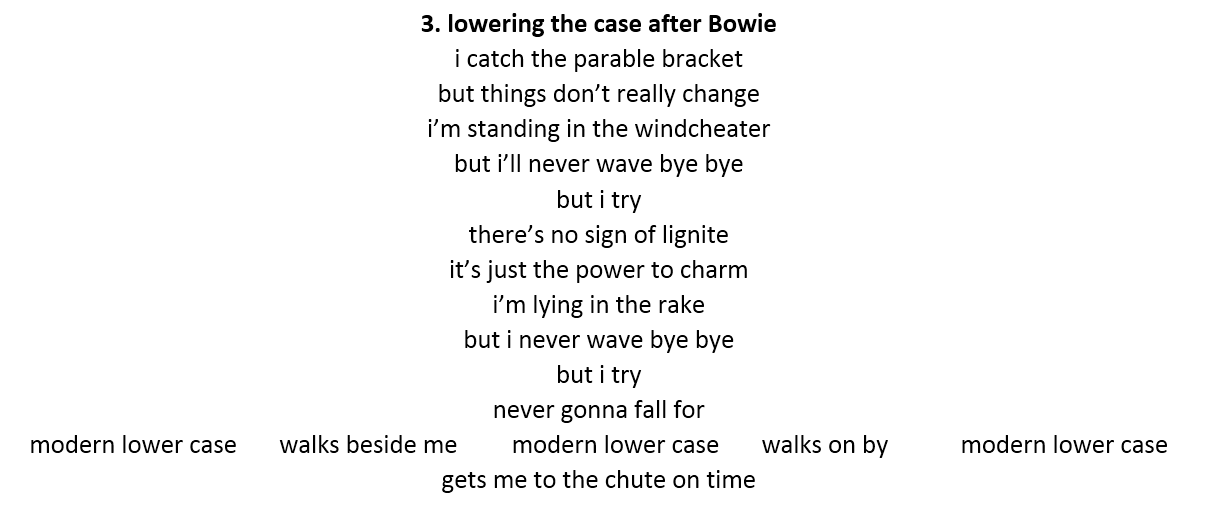
lower case oulipo — July 3, 2015
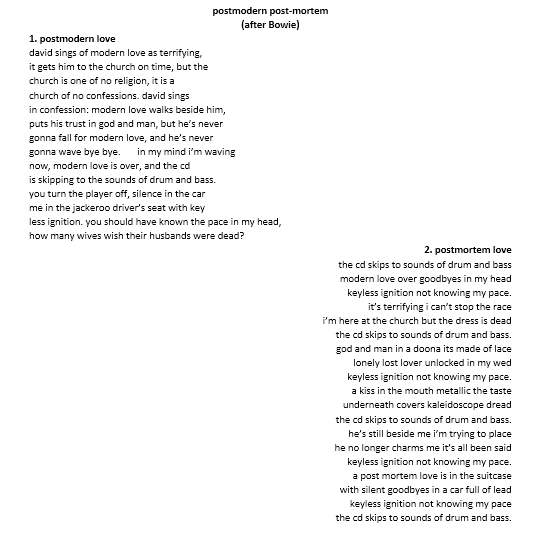
postmodern postmortem —